
Plenty of window and door makers want a 3D product configurator on their website. Few get one that works well. The reason sounds odd at first: the hard part is rarely the 3D models. It is the size. Furniture changes color, lamps change temperature, and the geometry stays put. A window does not work that way. One customer measures 2400 by 1800 mm, the neighbor measures 2700 by 2200, and every part of that window, from profile cuts to glass divisions to hinge placement, has to regenerate around those numbers.
So before comparing quotes from vendors, it helps to understand where the real work sits. For window and door projects, it sits in parametric sizing, and it separates this industry from almost every other one.
Size is an input, not an option
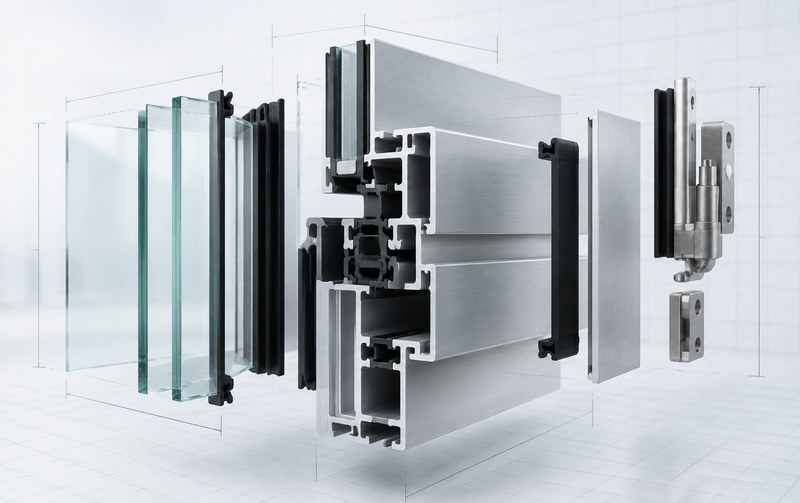
Most configurators run on a fixed list of choices. Six colors, three materials, two grades, and the combinations are countable. Window width and height are continuous variables, adjustable to the millimeter. When a customer types a new number, the model rebuilds on the spot. The mullion shifts, glass panels split differently, and if an opening sash exceeds what the hardware allows, the system has to block that combination before the customer gets attached to it.
This is why a window and door configurator is not a model switching tool. It is a parametric assembly system. Profiles, glass and hardware are separate components, each carrying its own rules, fitted together like blocks for every new size. The modeling effort runs higher than a set of fixed models, and the rule work up front usually takes longer than the modeling itself. Our 3D configurator service treats this as its own phase for window projects, separate from production.
Glass presentation deserves a note too. Low E coatings, cavities, triple glazing, these barely show in a plain front view. Section cuts and surface reflections are what let a customer actually see what the upgrade buys. Photovoltaic configurators face the same issue, and the way selection rules get handled there is worth a look in our PV configurator article.
Two audiences, two ways of using it
The window trade runs on two channels, projects and retail, and the same window door configurator serves them differently.
Project buyers, developers, facade contractors and distributors, care about compliance and speed. Does the profile series match the drawings, does the hardware package meet the project spec, does the whole window hit its thermal target. For them the configurator works like a proposal checker, ending in a full parameter sheet that goes straight into tender documents.
Retail customers want to understand. They picture the tilt and turn handle on their own wall opening and check whether the screen blocks the view. Professional parameters should stay hidden behind an effect first layout, with the technical layer folded away.
One system can carry both, but the interface logic splits in two: full parameters and bulk selection for the project side, style, color and opening type up front for homeowners. Projects that skip this split tend to fail in both directions at once.
Where pricing gets tricky
Window quotes are usually per square meter, but the cost structure counts pieces. Profiles by the meter, glass by area, hardware per set, sealing by process. Change the size and the weights shift. Small windows lean on hardware costs, large ones on glass.
The pricing logic inside the configurator needs that cost model, not a flat rate times area. How fine the granularity should be is best decided with the quoting team, since a rougher model is sometimes the more practical choice. For how configured options can flow into an inquiry, the basics are covered in our configurator logic article, and window projects add the size variable on top of that.
Windows and doors are among the strongest fits for configurators anywhere. Many options, strong custom intent, high unit value, all three boxes ticked. The difficulty is exactly why a finished system holds up as an advantage competitors cannot copy quickly.
Related Q&A
How many models does a window configurator need
Not one per unit type. One profile series breaks into parametric components for frame, glass, hardware and screens, and those cover any size within the series. The upfront work is close to what a dozen fixed models would take in other industries.
What happens when a customer enters a size that cannot be produced
The rule library sets hard limits. Profiles have maximum lengths, opening sashes have hardware load limits, and invalid combinations get greyed out with a prompt. Better a customer asks sales than configures a window the factory cannot build.
Can project orders and retail orders share one configurator
The rule base and models can be shared. The interface should not be. Project users need parameters and bulk tools, homeowners need pictures and guidance, and merging both usually leaves each side finding it hard to use.