
A catheter is nearly impossible to sell with photos. A minimally invasive catheter has a braided reinforced shaft, wires running inside, radiopaque markers at the distal end and a preformed tip, and the whole thing measures a few millimeters across. The factory behind this project used to send a short video plus a flat diagram with callout lines. Overseas buyers watched it and still could not picture the structure.
Earlier this year we took on a medical device 3D showcase project exactly like this. The walkthrough below breaks the process into stages, useful for any factory whose products are complex on the inside and small on the outside.
Modeling from CAD data
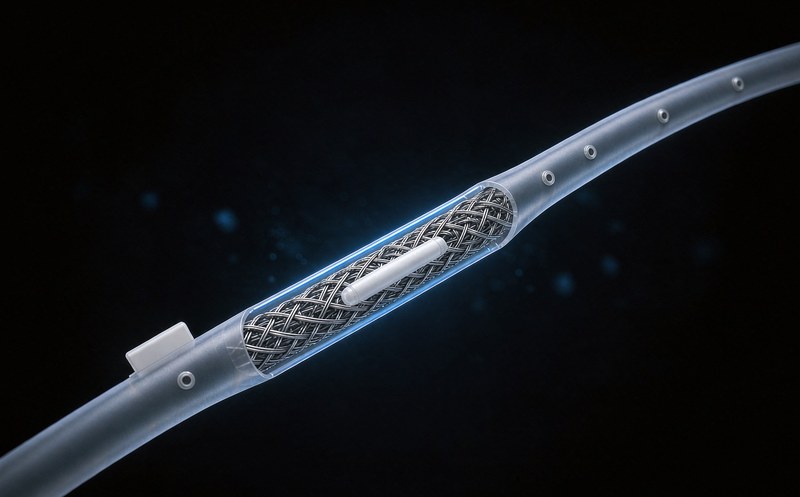
The client had complete CAD data, which is the precondition for a smooth project. Engineering models cannot go straight onto a web page though. Rendered at full engineering precision with fillets, threads and internal braiding, the polygon count would crush any browser.
Modeling for display does two things. First, rebuild the parts buyers actually care about, the braided layer, the marker rings, the shaft layers, and drop process details with no display value. Second, control the polygon budget so the model runs smoothly while still surviving a magnifying glass. Industrial modeling differs from consumer work here, a slightly wrong proportion is spotted instantly by a professional buyer. Where this stage sits in the bigger picture, the 3D product display workflow maps all six steps from modeling to launch.
Interaction design that lets buyers discover
A finished model is raw material. The real effort in this case went into the interaction layer, following the four levels of 3D product interaction, where each level up from simple rotation keeps visitors on the page longer.
The catheter project used three layers. The base layer is drag rotation with wheel zoom, close enough to inspect a marker ring a few millimeters wide. The second layer adds hotspots, tapping any spot on the shaft opens a note about that section, braiding material and angle for example. The third layer is a cutaway view, one slider moves the cutting plane and the internal wire routing appears. The sales team reported that questions about internal structure, which used to need a long video call, now get answered by sending one link.
When a product line has many variants, the next step is a full configurator where buyers pick options and watch the matching model update, one such build is included in our case collection. This project had only three catheter variants, so simple switching buttons were enough and a configurator was unnecessary.
Performance decides everything
Medical device buyers often open links on mobile data at a trade show, and a first screen that takes over five seconds loses most of them. The final model for this project came in at around three megabytes with placeholder loading and chunked streaming. The polygon budget must be fixed at the start of the project, resizing a finished model costs far more than planning ahead.
What changed after launch
The change showed up mostly in sales efficiency. Samples by courier and scheduled video calls used to be the standard path. Now many overseas buyers finish exploring the 3D interaction showcase before the first email and arrive with concrete structural questions. At trade shows the cutaway view on a tablet replaced the paper catalog almost entirely.
What transfers to other products
Any industrial product with complex internal structure that photos cannot explain fits this path of 3D product interaction. Two preconditions exist, CAD data and a list of common buyer questions. Modeling and interaction can be phased, launch the base layer first and decide on cutaways and exploded views after seeing the response.
Related Q&A
Do medical devices suit 3D interactive showcases
Yes, especially products that are structurally complex, physically tiny and impossible to photograph from inside, catheters, stents and anastomosis devices for example. Medical buyers are professional and care about internal structure, which is exactly what cutaway views and hotspots explain well. Display content should stay within industry compliance and keep claims restrained.
What materials does a 3D interactive showcase require
The core input is product CAD data, STEP or IGES format both work, and higher quality data means better reproduction. The second input is a list of common buyer questions, which decides the interaction levels, hotspot positions and cutaway planes. Sample photos or videos help the modeler match the material look.
Will 3D interaction slow a website down
Not when handled properly. A decimated and compressed model usually stays within a few megabytes, and with placeholder loading plus chunked streaming the page speed impact is manageable. What actually kills load time is uploading an untouched engineering model of several dozen megabytes, which nobody will wait for.