
How it differs from a plain 3D display
A regular 3D product display solves "hard to see": what the inside looks like, how the material feels. A product configurator solves "hard to decide": twenty colors, five materials, three grades, hundreds of combinations no catalog can cover and no salesperson can finish explaining. The former is a viewing tool; the latter is a decision tool.
Which products deserve a configurator
Three conditions; hit two and it is worth a serious look: many options (colors, materials, parts, sizes that combine), strong customization demand (buyers care about "made for me"), high price or decision cost (a wrong order hurts, so buyers double-check). Furniture, doors and windows, industrial equipment, vehicle accessories and jewelry are natural homes for configurators.
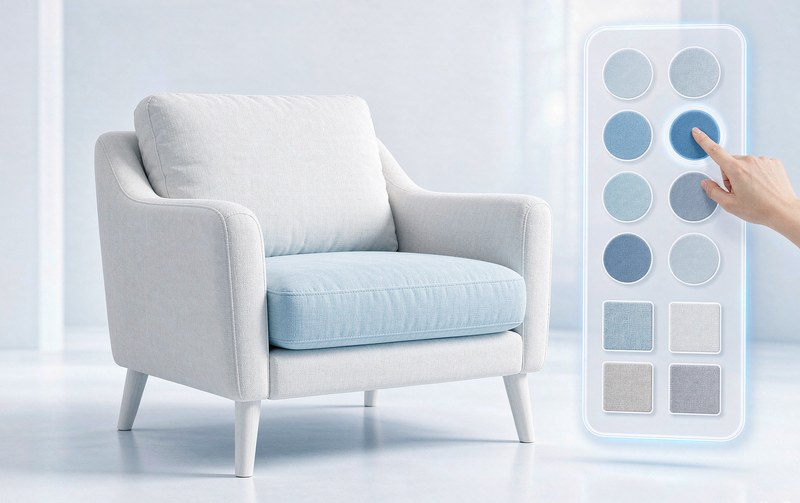
Where most configurators fail: the logic
The hardest part is not the model, it is the configuration logic. Plenty of configurators ship with fake switching: pick red and the heel material changes with it. Real logic handles three things: exclusions (choose A and B locks out), dependencies (a large size unlocks an accessory), and sensible defaults (buyers land on a complete standard configuration, not a blank slate). Get these right and customers trust that what they assembled on screen is what your factory can build.
Configuration data rides with the inquiry
An overlooked use: the full configuration travels with the inquiry. Instead of "I would like to ask something", sales receives a ready-made requirement sheet. Our 3D configurator development service follows exactly this idea; we also wrote a separate piece on quote linkage details.
Related Q&A
Which products suit a 3D configurator?
Hit two of three: large option space, strong customization intent, high price or decision cost. Furniture, doors and windows, industrial equipment, vehicle accessories and jewelry are the common industries.
How long does a configurator take to build?
A basic version for a simple product runs about one to two weeks; complex exclusion rules with quote linkage take three to six weeks, depending on the number of options and logic depth.
We have no 3D models. Is that a problem?
No. CAD data is ideal, but multi-angle photos plus dimension drawings also work, and modeling is normally part of the custom service.